
Movement-tracking technology is increasingly able to count repetitions, estimate joint angles and identify broad exercise patterns from a camera or wearable sensor. These functions appear well suited to fitness, but a yoga posture can challenge the assumptions behind the system. A practitioner may look still while making continuous, meaningful adjustments that are difficult for a device to detect.
This limitation is especially relevant in hatha yoga, where a posture may be held while attention shifts to pressure, breathing and muscular effort. Digital feedback can support practice, but it cannot reliably determine whether a visually accurate shape is comfortable, appropriately loaded or suitable for the individual.
Stillness Contains Constant Movement
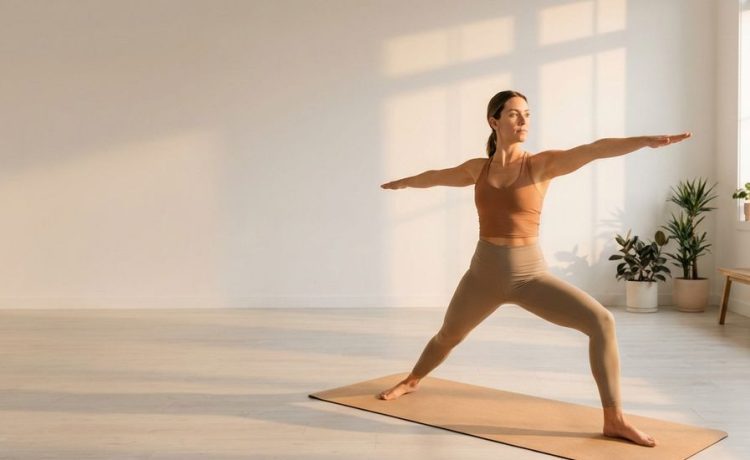
No standing posture is completely motionless. The feet adjust pressure, the ankles make small corrections and breathing changes the rib cage and centre of mass.
These movements may be too small for a standard camera to capture consistently. If an algorithm smooths the data to reduce visual noise, it may remove the very corrections that reveal how the practitioner is balancing.
Cameras Estimate Rather Than See the Skeleton
Most camera-based systems identify visible landmarks such as shoulders, hips, knees and ankles. They then estimate the body’s underlying joint positions.
Clothing, lighting and camera angle affect these estimates. A loose shirt can obscure the waist, while one limb passing behind another can hide key points. The software does not directly observe bones, joint surfaces or muscular tension.
Two-Dimensional Views Lose Depth
A single front-facing camera captures height and width more easily than movement towards or away from the lens. Rotation at the hips or rib cage may therefore be misread.
The practitioner might appear to achieve a particular angle while the body is turning in another plane. A side view can add information, but it introduces setup complexity and still cannot reproduce a full three-dimensional assessment.
Individual Proportions Change the Appearance
People with different limb lengths, torso proportions and joint structures will not create identical shapes. A universal model may mark one person as misaligned simply because their body expresses the posture differently.
This becomes a problem when the system treats visual symmetry as the goal. Appropriate stance width and joint angle depend on the individual and the purpose of the movement, not only on a reference image.
A Correct Angle Can Hide an Unhelpful Strategy
Two people may produce the same knee angle while distributing pressure differently through the foot and hip. One may feel stable, while the other is gripping, collapsing or experiencing pain.
A camera score can reward the final geometry without detecting how it was achieved. Digital alignment should therefore be treated as one observation, not proof of movement quality.
Muscular Effort Is Largely Invisible
In a held posture, the practitioner may increase force without changing position. The quadriceps, hips or shoulders can fatigue while the outline remains nearly identical.
Wearable muscle sensors exist, but consumer pose-tracking systems rarely measure comprehensive muscular activity. Even when data is available, interpreting whether the effort is appropriate requires context.
Breathing Is Difficult to Interpret Visually
A camera may detect large chest movement, but quiet diaphragmatic breathing can be subtle. Loose clothing and body position further obscure respiratory motion.
The device also cannot easily distinguish a controlled pause from an involuntary breath hold caused by strain. Asking the practitioner how breathing feels may provide more useful information than a visual breath score.
Pressure Distribution Is Missing
Yoga teachers often cue practitioners to notice weight through the heel, forefoot or different parts of the hands. Ordinary cameras cannot measure this contact directly.
Pressure mats and instrumented insoles can provide data, but they are not standard in most home setups. Without them, an app may assume equal loading because the body looks centred.
Pain and Comfort Cannot Be Inferred Safely
A person can maintain an aesthetically precise posture while experiencing joint pain, numbness or dizziness. Another person may use an unconventional but comfortable variation.
Software should never encourage someone to remain because the pose score is high. Subjective symptoms and relevant medical guidance take priority over geometric feedback.
Stillness Confuses Repetition-Based Metrics
Fitness platforms commonly measure work through repetitions, distance or speed. A held posture does not fit these models neatly.
Duration is easy to time, but a longer hold is not always better. If technique deteriorates or the practitioner becomes uncomfortable, extending the timer rewards the wrong outcome.
Occlusion Creates Tracking Gaps
In twists, binds and folded positions, one body part may block another from the camera. Hands can disappear behind the torso, and knees may overlap from the chosen angle.
The system may guess the missing location based on previous frames. That prediction can look smooth on screen while being inaccurate. Users should not assume a confident graphic indicates reliable measurement.
Small Camera Errors Can Produce Large Scores
If a landmark shifts by a few pixels, the calculated joint angle may change. Distance from the camera and image resolution influence the size of this error.
Apps that display highly precise numbers can create false confidence. A reading of a specific angle does not mean the true body position was measured to the same precision.
Wearables Have Their Own Limitations
Wrist devices can estimate heart rate and general motion, but they know little about the position of the hips, knees or spine. Multiple body sensors improve coverage but require correct placement and calibration.
Sensors may also move relative to the skin or clothing during practice. The resulting data needs interpretation, especially when the device converts it into a simple quality score.
Heart Rate Does Not Equal Pose Quality
Heart rate can indicate general physiological response, yet it cannot show whether weight is distributed well or whether a joint feels stable. Stress, caffeine, heat and hydration can alter the reading.
A low heart rate does not prove that a posture is restorative, and a higher reading does not automatically mean poor technique. The metric answers a different question.
Digital Feedback Can Still Be Useful
Technology may help practitioners remember a sequence, observe broad movement patterns or compare a recording over time. Timers can support balanced practice when they do not encourage excessive duration.
Video can also provide material for a qualified teacher to review. Its value increases when the camera angle, task and practitioner’s own sensations are discussed rather than reduced to an automated score.
Privacy Deserves Attention
Pose-tracking systems may record the inside of a home, body images and health-related information. Users should understand whether footage is processed locally, uploaded or retained.
Account security, data-sharing settings and deletion controls matter. A convenient feature should not require users to disclose more visual or biometric information than they are comfortable providing.
Good Technology Communicates Uncertainty
A responsible system should acknowledge when landmarks are hidden, confidence is low or the camera angle is unsuitable. It should avoid diagnosing injuries or making rigid claims about perfect alignment.
Feedback is more useful when it suggests options, such as changing the camera position or consulting an instructor, rather than presenting every deviation as an error.
Combine Data with Human Observation
At Yoga Edition, practitioners can receive real-time guidance that considers breathing, confidence, previous experience and the purpose of the posture. These contextual observations are difficult to encode in a generic tracking model.
Digital tools are strongest when they extend reflection rather than replace judgement. Stillness in Hatha practice contains pressure shifts, effort and sensation that may never appear in a clean on-screen skeleton. Recognising that gap helps practitioners use technology without giving it authority it has not earned.
Frequently Asked Questions
Can a yoga app accurately correct my posture?
It may identify broad visual differences, but camera angle, body proportions and hidden joints limit accuracy. It cannot assess pain or suitability.
Why does pose tracking lose my joints?
Loose clothing, low light, camera position and overlapping limbs can obscure landmarks. The system may then estimate or lose the point.
Is a higher pose score always better?
No. A score may reward resemblance to a reference shape without measuring comfort, pressure distribution or individual structure.
Can a smartwatch measure Hatha yoga effort?
It can estimate heart rate and general activity, but it cannot fully measure muscular tension, alignment or movement quality.
Is recording yoga practice safe for privacy?
It depends on how the platform processes, stores and shares footage. Review permissions, retention and deletion settings before recording.
Can technology replace an instructor?
No. It can support reminders and observation, but it lacks the contextual judgement, communication and adaptation a qualified instructor provides.